Scientific guide · Published October 23, 2026 · Updated October 23, 2026
Daily tadalafil scores: interrogating a treatment promise
Questionnaire points describe a particular measurement. Reading them as a purchase promise requires additional assumptions about starting position, comparison and personal meaning.
AI-assisted public-document editorial research · No clinician sign-off or firsthand treatment testing. Source access dates appear with each reference.
A score can make improvement look unusually portable. A number moves upward, and a reader may imagine that the movement can be carried directly into an expectation about treatment. Yet the meaning depends on the instrument, its starting value and the question being asked. This article follows those dependencies through original examples. It does not allege that a named service cites this study or that a questionnaire can decide whether an individual should receive treatment.
Porst randomized men with ED to blinded oral-tadalafil or placebo treatment. Missing IIEF-EF scores used last observation carried forward. LillyICOS funded the study, with Lilly writing/analysis assistance and company-affiliated authors. The accompanying figure provides the reported estimates. The examples in the discussion use invented scales and records to explain interpretation; their values are not trial observations, questionnaire thresholds or forecasts.
Study overview
- Identify the instrument
IIEF-EF refers to the erectile-function domain of the International Index of Erectile Function.
- Read the movement
A difference between two measurements does not reveal either measurement on its own.
- Retain the comparison
Improvement within one group and a contrast between groups are distinct calculations.
- Ask about personal meaning
A numerical change needs a defined interpretation before becoming a statement about an individual experience.
Trial figure and data
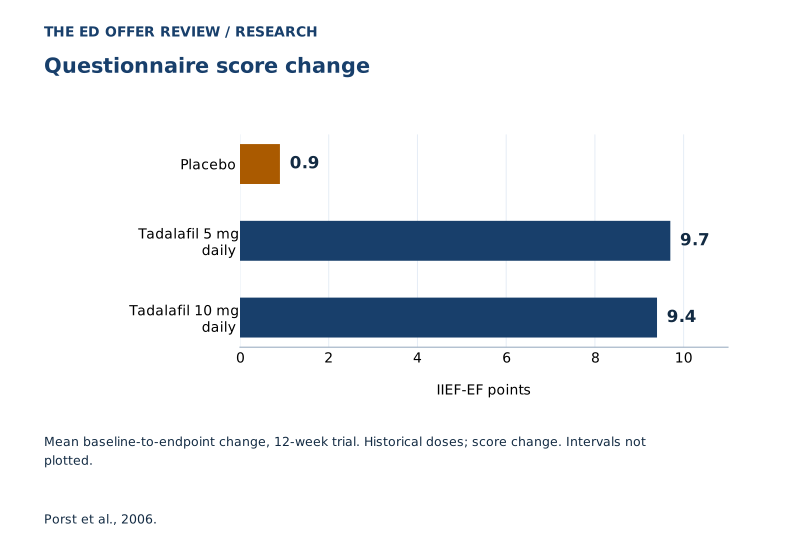
Download chart (PNG)Download data (CSV)Download vector (SVG)
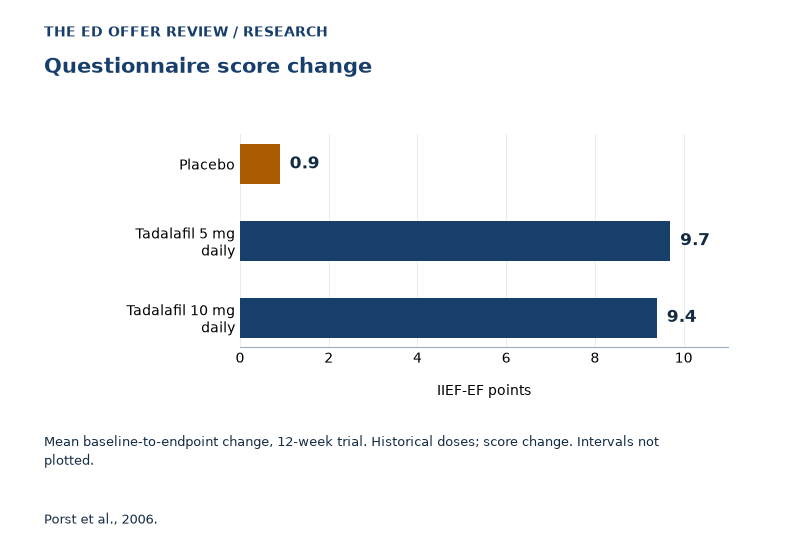
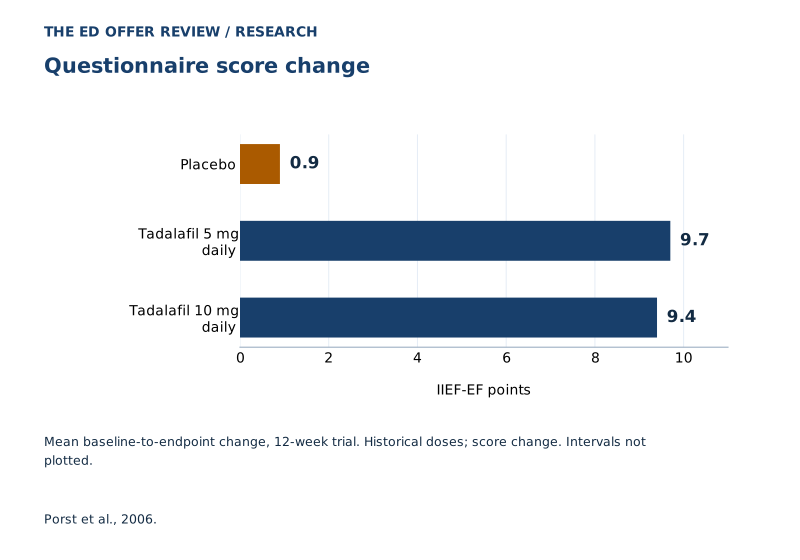
| Group | Mean change |
|---|---|
| Placebo | 0.9 |
| Tadalafil 5 mg daily | 9.7 |
| Tadalafil 10 mg daily | 9.4 |
Mean baseline-to-endpoint change, 12-week trial.
Historical doses; score change. Intervals not plotted.
The instrument gives a point its meaning
Imagine two invented questionnaires, each returning a number called a score. One asks about how often an event occurred; the other asks how troublesome an experience felt. Even if both produce a value of ten, those tens do not describe the same thing. The number has meaning only within the rules that produced it. A point is therefore not a free-standing unit that can be carried from one instrument into another.
Before interpreting a numerical claim, identify the question the instrument was designed to summarize. Then distinguish the complete questionnaire from any particular part used in an analysis. This is a method of reading measurement descriptions, not a substitute for examining the instrument. It also avoids treating a broad everyday word such as satisfaction as though every study measured all of its possible meanings.
An individual account may describe an important experience in ordinary language without using the same measurement system. Our testimonials guide provides another way to examine that gap. Neither a personal description nor a questionnaire total should silently supply information absent from the other. The most useful first question is what the numerical result actually represents.
A point change is not a percentage
Consider an invented scale extending from zero to twenty. A change from four to nine is five points. It is not five percent, and it does not say that five percent of people improved. Dividing the change by the initial value would produce a relative-change calculation, but that is a new operation with its own interpretation. It must not be substituted for the original unit without explaining what was done.
The same example shows why apparently simple conversions can be unstable. A five-point change starting at one produces a very different relative percentage from a five-point change starting at ten. The absolute movement is unchanged. The percentage is sensitive to the chosen starting denominator. If the initial value is zero, the proposed relative-change calculation cannot be performed in the usual way. None of these arithmetic properties establishes a clinical meaning.
When an offer uses a percentage sign, look for the event and denominator that justify it. When it uses points, look for the instrument and the comparison. A precise label protects the reader from interpreting one type of quantity as another. These examples concern a fictional scale and do not reproduce proprietary questionnaire items.
Starting positions remain part of the result
Suppose two fictional people improve by four points on that same invented scale. One moves from three to seven; the other moves from twelve to sixteen. Their changes are equal, while their final positions differ. A report containing only the change would not allow a reader to recover either final value. It is one equation with more than one unknown unless a starting value is also supplied.
The reverse comparison is possible too. Imagine two people ending at fourteen after starting at eight and twelve. The endpoint is the same, but the changes are six and two. Neither summary is inherently more honest; they describe different features of the records. A claim should explain which feature it is using and why that feature answers the proposed question.
For a personal expectation, an additional problem remains: an observed starting score does not determine the future change. Attaching a group average to an individual baseline constructs an estimate; it does not make that estimate an observed outcome. The table keeps these operations distinct. Its numbers belong solely to the illustrative scale, with no suggested diagnostic interpretation.
| Illustrative record | Arithmetic description | What remains unresolved |
|---|---|---|
| Three to seven | Four-point increase | What that movement means to the person |
| Twelve to sixteen | Four-point increase | Why the final position differs |
| Eight to fourteen | Six-point increase | Whether another person would change similarly |
A mean change leaves room for different paths
Imagine four invented changes of zero, two, eight and ten points. Their mean change is five. A second invented group has changes of five points for every person and therefore the same mean. A single summary cannot distinguish these distributions. It does not identify how many people changed very little, how many changed substantially or whether their experiences shared a pattern beyond the arithmetic average.
Change also leaves the path between measurements unspecified. A fictional person could reach an endpoint gradually, reach it early and remain there, or fluctuate before the final observation. Matching the initial and final numbers would conceal those different trajectories. A claim about consistency over time therefore asks for a different description from a claim about movement between two measurements.
This distinction is useful when an offer uses language such as reliable improvement. The word reliable might refer to measurement repeatability, regularity of experience, or confidence in a group estimate. Those meanings should be named rather than blended. An average change alone does not select among them, and an attractive graph does not resolve the ambiguity of the accompanying sentence.
Separate change over time from the treatment contrast
In an imaginary comparison, one group gains seven points and another gains two. Subtracting the changes gives a five-point contrast. The seven-point movement and the five-point contrast are both legitimate arithmetic descriptions, but they answer different questions. Calling the larger number the difference between treatments would erase the change observed in the comparison group.
A comparison is most useful when its design supports the question being asked. Allocation, observation and analysis rules all belong in the reasoning. Random assignment concerns how groups are formed; it does not make every individual identical or remove every source of uncertainty. Blinding concerns knowledge of allocation; it does not transform a reported experience into a direct observation of every underlying biological process. These are conceptual distinctions, not estimates of how much any factor affected this trial.
For a treatment promise, identify whether the claim concerns change within a group, the difference from a comparator, or an individual response. Move between those descriptions only when the required information is available. Otherwise the wording can grow more confident while the evidence remains unchanged. A useful explanation makes the comparison visible instead of leaving the reader to invent it.
An assigned value is different from a new observation
Consider an invented record containing a score of eleven at one visit and no score at the next. Carrying the earlier value forward makes eleven the value used at the later point. It does not create a new measurement. The distinction matters because the completed analysis can look like an ordinary set of observations even though some entries represent a rule applied to missing information.
Different possible later values would lead to different changes. If the unobserved score were lower, carrying eleven forward would overstate that fictional endpoint; if it were higher, it would understate it. Without the missing observation, the direction cannot be established from the rule alone. This is why a clear description of missing-data handling is useful even when a reader is not attempting a separate statistical analysis.
It is also necessary to ask which measurement a rule covers. A method specified for one questionnaire does not automatically describe how a separate diary was handled. Keep the rule attached to its outcome. An offer that combines several outcomes into one promise should not gain apparent completeness by leaving those distinctions out. The example here illustrates a method, not an alternative estimate for the published groups.
The taller bar does not settle every comparison
Two displayed estimates can differ without establishing the precise conclusion a reader wants to draw. Deciding that an alternative is superior, sufficiently similar, or more suitable for a particular person involves different questions. Similar-looking numbers do not prove equivalence. Nor does a small visible difference automatically establish an important advantage. The interpretation depends on the comparison specified and the uncertainty attached to it.
A bar chart also compresses information. Its tidy edge is not evidence that the estimate has no uncertainty, and an omitted interval should not be mistaken for an interval of zero width. Variation between individuals, precision of an estimated mean and relevance to a new setting are separate concerns. A single visual feature cannot answer all three.
The sildenafil count analysis provides a useful contrast in measurement. It discusses event counts rather than questionnaire points. Those quantities cannot be ranked by their numerical size. An informative comparison would need a common question and a defensible design; placing unrelated endpoints in adjacent advertising boxes does not supply either. The following table is an editorial reading aid, not a new clinical comparison.
| Proposed conclusion | Evidence question | Unhelpful shortcut |
|---|---|---|
| One option is superior | Was that specific comparison evaluated? | Choose whichever plotted number is larger |
| Options are equivalent | Was an appropriate equivalence question tested? | Treat nearby numbers as proof of sameness |
| A result applies to me | How does the study relate to my circumstances? | Replace an individual assessment with a group mean |
Check what changes between the study and the offer
FDA explains that compounded preparations do not receive FDA approval or the agency’s premarket review of safety, effectiveness and quality. Compounding can address medical needs, while failures of quality can produce serious harm. This establishes a regulatory distinction; it does not by itself evaluate a particular seller, prescription or finished preparation.
For an original document-reading exercise, make two descriptions side by side. One identifies the intervention studied. The other identifies the preparation being discussed now. Record any differences in formulation, route, ingredients and regimen, then ask what evidence addresses each difference. An empty space is a question to pursue. It is not proof of equivalence, and it is not proof that every alternative must perform badly.
The formula-evidence guide expands that comparison. The Hims provider review is a route into documentary questions about an offer; linking it here supplies no assurance of availability or outcomes. A familiar name can make two descriptions feel close. The scientific task is to establish the relevant connection rather than rely on that feeling. The same scrutiny applies whether the promotional language is cautious or emphatic.
Keep the historical regimen beside current labeling
Cialis labeling describes daily ED regimens of 2.5 or 5 mg; the trial’s 10 mg daily arm is outside that routine labeled schedule. These figures identify records, not a personal prescription. Nitrates, riociguat and serious hypersensitivity are contraindications. Cardiovascular suitability and interacting medicines require assessment. Listed common reactions include headache, indigestion, back pain and muscle pain.
An erection lasting beyond four hours requires emergency care. Stop tadalafil and seek prompt medical attention for sudden vision loss or a sudden hearing decrease. Stop sexual activity and get immediate help for chest pain, dizziness or nausea during sex. These label-based safety points are a separate part of the decision; a favorable questionnaire result cannot screen for them.
In an offer-reading exercise, reserve a separate place for current instructions, safety questions and clinical follow-up. Do not place them inside a single score or treat them as optional deductions from a benefit estimate. The resulting record should help a clinician understand what the reader is asking, without pretending that a published group result has already answered an individual prescribing question.
Translate the result into questions, not a quota
A purchase includes defined goods or services; a questionnaire change describes a measurement. Dividing a price by a score change would create a ratio, but it would not identify the cost of a guaranteed improvement for an individual. The order-price guide helps keep the commercial numerator explicit. The outcome denominator would need its own matched evidence rather than an expectation borrowed from a study.
Likewise, a score does not measure how quickly an effect begins or how long an encounter lasts. Those claims belong to the timing-evidence discussion. Write the specific question in ordinary language before deciding which research result might help answer it. This prevents an available number from defining the question merely because it is convenient to display.
A final document check can follow the Ro review, while leaving clinical interpretation with the appropriate clinician. Retain the instrument name, comparison and unresolved assumptions alongside any offer description. The useful outcome is a question that another person can examine and answer. It need not be compressed into a promise of points, a ranking of medicines or a prediction about a particular encounter.
Questions about the evidence
Are questionnaire points a percentage of improvement?
A point is defined by its measurement system. A percentage requires a specified denominator and calculation. Neither a count of improved people nor a proportional improvement follows from a point change alone. Read the unit as part of the result, rather than as a label that can be exchanged for a more familiar one.
Can the average change predict my final score?
Adding a group mean change to an individual starting value produces a constructed estimate. It does not reveal a future observation. The average also leaves individual variation unresolved. A personal interpretation requires information beyond that single calculation, including the clinical context and what the outcome would mean to the person.
Does a missing observation mean no improvement occurred?
Absence of a measurement does not establish the value it would have taken. An analysis may use a stated rule to handle that absence, but the assigned value remains different from a newly collected observation. Ask how the rule affects the question being answered instead of treating missingness as an outcome.
Why not choose the regimen with the larger number?
The larger displayed estimate does not answer every comparison or an individual suitability question. Superiority, equivalence and personal preference each require appropriate reasoning and evidence. Historical study labels also should not be read as a menu of current prescribing instructions.
What should I retain when discussing an offer?
Keep the exact preparation description, the claim you want evaluated and the research measurement offered in support. Record the gap between them in plain language. That makes it easier to request a relevant answer without assuming that a shared ingredient or an appealing score has already closed the gap.
Editorial assessment
A questionnaire result becomes useful when its meaning remains attached to its measurement. Preserve the scale, the comparison and the distinction between observed and assigned values. Original arithmetic examples can expose assumptions, but they cannot supply missing clinical evidence. The responsible next step is to ask which part of an offer the result actually addresses and which part still needs a product-specific or individual answer. A careful question is a stronger foundation for discussion than a numerical promise assembled from incompatible records.
Research access and limitations
Complete retained papers were examined; direct re-downloads were restricted. Separate protocols, supplements and individual data were not reviewed. The invented examples illustrate reasoning rather than reanalyzing the research. No questionnaire items are reproduced.
Original sources
Access notes distinguish the research examined from current prescribing and regulatory information.
- Cialis (tadalafil) prescribing informationCurrent prescribing information · Checked October 23, 2026Source-register context →
- Porst et al. (2006): daily tadalafil trialRetained primary paper; recheck restricted · Checked October 23, 2026Exhibit PDF (recheck restricted)Source-register context →
- Understanding the risks of compounded drugsFDA public information · Checked October 23, 2026Source-register context →
- Goldstein et al. (1998): oral sildenafil trialRetained primary paper; recheck restricted · Checked October 23, 2026Exhibit PDF (recheck restricted)Source-register context →