Scientific guide · Published October 23, 2026 · Updated October 23, 2026
Sildenafil counts: inspecting the promise in an offer
A group result becomes a different proposition when an advertisement presents it as a personal expectation. Follow the unit, observation window and missing assumptions.
AI-assisted public-document editorial research · No clinician sign-off or firsthand treatment testing. Source access dates appear with each reference.
A number in an offer can look precise while leaving its promise unclear. Does it describe an observed event, a typical person, the likelihood of a future encounter, or something included in a purchase? Those are different propositions. This reading treats the study figure as the beginning of an inquiry: what would have to be known before a reader could reasonably connect its result to a commercial claim? No particular advertiser is alleged to have cited this paper.
Goldstein studied men with ED in randomized, blinded oral-sildenafil comparisons. Pfizer funded the research and assisted design, logistics and analysis; author consulting and a company affiliation were disclosed. The discussion below develops original measurement examples rather than additional trial findings. Every invented example is a teaching device, with numbers chosen to make the reasoning visible. It does not recreate participant records or forecast a response.
Study overview
- Name the proposition
Separate an observation about a group from a promise made to an individual.
- Preserve the unit
A count, a probability and an allotted quantity answer different questions.
- Ask about exposure
A total becomes interpretable only when its observation window and opportunities are understood.
- Check the preparation
An ingredient name does not supply the missing evidence for a different finished product.
- Keep the decision clinical
A research average cannot perform an individual medication or cardiovascular assessment.
Trial figure and data
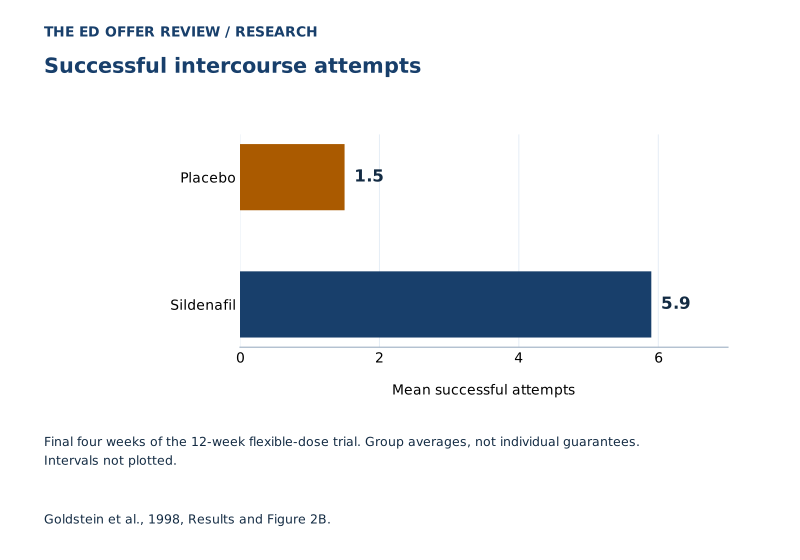
Download chart (PNG)Download data (CSV)Download vector (SVG)
| Group | Mean count |
|---|---|
| Placebo | 1.5 |
| Sildenafil | 5.9 |
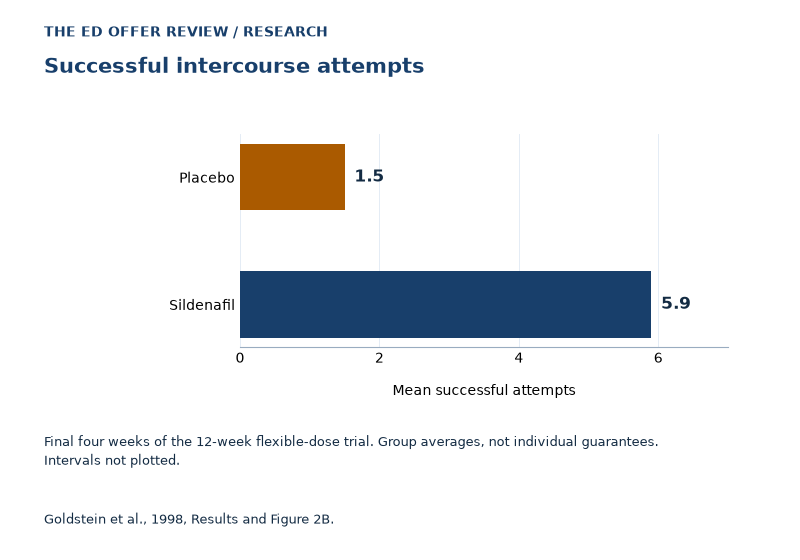
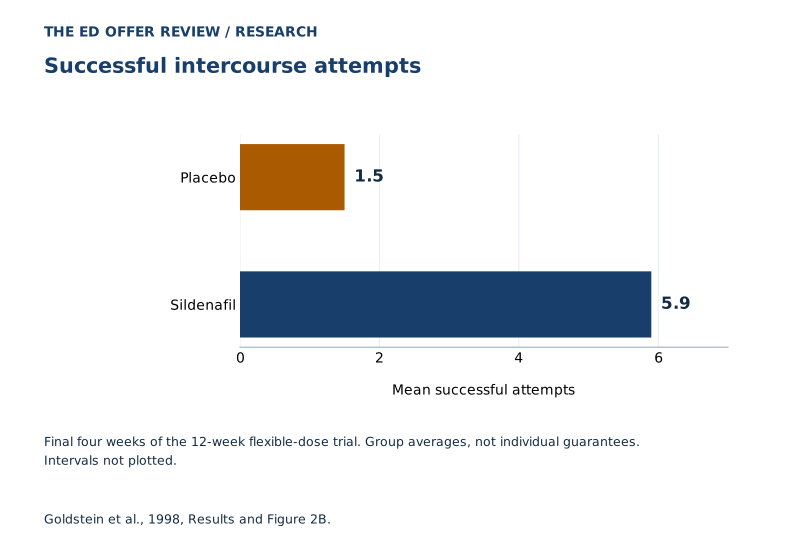
Final four weeks of the 12-week flexible-dose trial.
Group averages, not individual guarantees. Intervals not plotted.
Find the noun beside the number
Start by removing the persuasive wording from an imaginary headline: “More success with treatment.” The phrase does not yet identify an observable quantity. A more complete statement would name what was counted, whose records contributed, the comparison being made and the period covered. This is an editorial method for unpacking a claim. It does not assume that the advertiser has actually measured any of those things.
Now imagine a fictional report listing twelve successful events among a small group. Twelve is a total. Dividing it by the number of people could produce an average count. Dividing it by the number of attempts could produce a proportion. Neither calculation is available until the appropriate denominator is supplied. Changing the denominator changes the question, even when the numerator remains exactly the same. Adding a percent sign would therefore create information, not merely simplify the presentation.
A personal story introduces another level of evidence. One account may identify an outcome the storyteller values without supplying a group estimate at all. Our guide to reading testimonials examines that distinction. The practical question is whether the claim presents the kind of evidence it actually possesses.
A comparison needs an alternative history
An outcome observed after treatment does not, by arithmetic alone, reveal what would have happened without that treatment. Suppose an invented group records twenty events after entering a program. Calling all twenty events a treatment effect silently assigns zero events to the alternative history. That assignment is a separate assumption. A comparison group makes the alternative observable at group level, although it never supplies a second history for the same individual.
Consider a second fictional group with fourteen events during an equivalent window. The difference between the totals is six, but interpreting it still requires the group sizes, observation rules and allocation method. If one group contains twice as many people, the raw totals are not comparable measures of individual experience. If observation periods differ, time is another unresolved part of the calculation. A subtraction can be correct while the resulting interpretation is incomplete.
For an offer, this leads to two distinct questions: what evidence supports a difference between alternatives, and what evidence supports the expectation being presented to this particular reader? A study can help with the first question without turning the second into a guarantee.
Match the observation window to the claim
A fictional six-event total collected over two weeks is not the same measurement as six events collected over eight weeks. The count alone hides the difference. Dividing by weeks produces an average per week, but that operation adds a new summary; it does not establish that events occurred at regular intervals. They might all have occurred near the beginning, near the end, or unevenly throughout the observation period.
Extrapolation requires still more assumptions. Multiplying a short-window average by a year presumes that the relevant conditions remain sufficiently similar. The arithmetic cannot establish that continuity. When an offer places a monthly price beside an outcome reported over another period, the matching word “monthly” may seem natural even though the records have not actually been aligned. A billing cycle and an observation window are independent definitions.
Timing language also needs its own evidence. An event count cannot be rearranged into a statement about how quickly a medicine acts or how long a particular encounter will last. The timing-claim guide offers a place to examine those propositions separately. Keep the original window attached to the measurement before making any comparison.
Separate opportunity, attempt and outcome
Imagine two fictional records with six successful events each. In the first, six attempts were recorded; in the second, twelve were recorded. The successful-event counts match, while the proportions differ. Conversely, two records can have the same proportion and different counts. This example explains why a result should retain its own unit instead of being translated into whichever unit makes an offer sound strongest.
Opportunity is another concept. A diary entry can document an attempt, but the number of recorded attempts is not automatically the number of occasions on which someone wanted an encounter, had privacy, felt comfortable or had a willing partner. These imagined circumstances illustrate possible distinctions, not explanations established for the trial participants. The missing information cannot be reconstructed from a successful-event total.
The same distinction matters when an offer refers to a supplied quantity. A package count describes items. It does not enumerate opportunities, attempts or outcomes. A useful reading keeps those categories separate and asks which one a statement actually measures. The table presents conceptual questions, not additional observations from the research.
| Quantity | Question it can frame | Information still needed |
|---|---|---|
| Successful-event count | How many recorded events met the definition? | Observation window and contributing records |
| Attempt proportion | What share of recorded attempts met the definition? | Attempt denominator and handling of missing entries |
| Supplied quantity | How many items are included? | Prescription, use and clinical outcome remain separate |
An average does not describe every reader
Take four invented counts: zero, zero, four and eight. Their total is twelve and their mean is three. Another invented set contains three, three, three and three. It has the same mean, although the experiences represented are entirely different. These deliberately simple examples show that the average does not reveal the full distribution. They are not a reconstruction of either study group.
A statement that “the average was three” can therefore be accurate without identifying a typical experience in the everyday sense. It cannot tell us how many people had no recorded events, how many exceeded the average, or how widely their experiences differed. Those questions require further summaries or individual observations. The presence of a decimal in a mean is also ordinary: averaging whole-number counts need not produce another whole number.
An offer becomes stronger than its supporting calculation if it turns that average into an amount owed to each person. The scientific question is about a distribution under defined conditions. The purchasing question concerns the promise being made. Keeping both questions visible prevents a group summary from quietly becoming a personal entitlement.
Why price divided by a trial mean misleads
Suppose a fictional subscription costs one hundred units of currency and a separate research summary reports a mean of four events. Dividing one hundred by four gives twenty-five. The quotient is mathematically valid, but labeling it a personal cost per successful event combines unrelated records: the fictional price, the group average and an individual whose outcome has not been observed. None of the inputs establishes that all four events will occur for that person.
Even a retrospective calculation would require careful definitions. Does the numerator include consultation charges, a prescription, shipping, unused items and later billing? Does the denominator include only events within the same period? What happens when the count is zero? In that case the proposed division has no finite result. These are questions about constructing a metric, not estimates of any service’s actual costs.
The price-per-order guide helps separate the commercial records. Keep a cost description tied to what is purchased and an outcome description tied to what was observed. Combining them may be useful for a clearly specified analysis, but it demands matching data and explicit assumptions rather than an attractive ratio.
Missing records change the question being answered
Consider a hypothetical reporting period with ten expected entries and seven completed entries. A summary of the seven available records describes what was observed. Treating the other three as unsuccessful would answer a different question, while treating them as successful would answer another. Neither assignment follows simply from their absence. Missingness is a property of the record; it is not an outcome category by itself.
A useful sensitivity exercise can make the consequence visible without pretending to resolve it. Imagine four successes among the seven observed entries. Four out of seven describes those entries. Four out of ten would result from assigning failure to every missing entry; seven out of ten would result from assigning success to all three. This deliberately artificial range is a lesson in assumptions, not a confidence interval and not an analysis of the original trial.
When reading an offer’s cited evidence, ask for the analysis rules before interpreting a tidy headline. Which observations were eligible? Which records were unavailable? What assumptions filled any gaps? The absence of those details from an advertisement does not prove an error, but it limits the precision of the conclusion a reader can independently check.
Follow the result to the finished preparation
FDA states that compounded drugs are not FDA-approved and receive no agency premarket assessment of safety, effectiveness or quality. They can meet medical needs, but quality failures may cause serious harm. This regulatory distinction identifies a question that a shared ingredient name cannot answer: what evidence concerns the actual preparation being offered?
Think of an evidence chain as a sequence of specified objects: a study intervention, a manufactured or compounded preparation, a prescription and a supplied item. This is an original way of organizing the documents, not a claim that all such chains are incomplete. If two descriptions differ, write down the difference rather than erasing it with the common ingredient name. The four-ingredient evidence guide gives that comparison more room.
A provider review is useful here as a route into documentary questions. The Hims review can help a reader identify which product description to examine; the link does not establish availability, equivalence or a clinical result. Ask what bridges the research intervention to the exact preparation under discussion, and whether the response supplies evidence or simply repeats the ingredient.
Read benefit and safety on separate lines
The Viagra label contraindicates nitrates, riociguat and hypersensitivity, and warns against use when cardiovascular status makes sexual activity inadvisable. Other medicines require review. Listed common reactions include headache, flushing and indigestion. Seek emergency care for an erection beyond four hours; stop sildenafil and obtain medical help for sudden vision loss or hearing decrease. Chest pain, dizziness or nausea during sex calls for stopping sexual activity and getting immediate medical help.
Those warnings are not a numerical discount that can be subtracted from an efficacy average. Benefit and harm have different definitions, and an individual assessment asks questions the plotted count cannot answer. An imaginary advertisement offering “more events with no tradeoff” would therefore need support for two propositions. Evidence concerning one outcome does not automatically settle every other outcome relevant to a decision.
A useful reading note has separate spaces for the desired outcome, the safety questions and the person responsible for answering them. That arrangement avoids letting a favorable number dominate the page. It also preserves the distinction between general information and a clinician’s assessment of the reader’s circumstances. No count in this article supplies a personal regimen.
Build a claim record that another reader can inspect
A claim record can be short: preserve the exact wording, identify the measured quantity, attach the observation period and state the proposed comparison. Then add a separate line for every assumption needed to apply it elsewhere. This is an editorial exercise, not a validated clinical instrument. Its purpose is to make the reasoning inspectable, including the point at which a documented observation gives way to an expectation.
An adjacent study may help explain another measurement without validating a ranking. Our daily tadalafil score analysis examines questionnaire change. A score and an event count are not exchangeable units. Placing their numbers next to each other does not create a common scale, and choosing the larger numeral would not identify the preferable treatment. An informative comparison first asks whether the studies answer the same question.
Keep the provider record alongside, but distinct from, the research record. The Ro review is another starting point for examining documentary terms, not a prediction of treatment performance. A complete reading can acknowledge a reported result while leaving a proposed personal or commercial interpretation unresolved. The table shows how to document that remaining step.
| Record | What to retain | Question for the next document |
|---|---|---|
| Research observation | Outcome definition, period and comparison | Does the proposed claim preserve all three? |
| Commercial description | Exact preparation and included services | Which parts are actually supported by the research? |
| Personal expectation | Desired outcome and unresolved assumptions | What requires individual clinical assessment? |
Questions about the evidence
Does a higher average promise more events for everyone?
No such promise follows from an average alone. A mean summarizes a set; different underlying distributions can produce the same value. To describe individual variation, ask for information that actually measures variation. Do not replace missing distributional evidence with an expectation selected from the headline.
Can I turn the chart into my chance of success?
That conversion would require a different measurement and a defined personal context. A count is not a probability merely because it concerns a desirable outcome. First identify the event definition and denominator required by the probability question; then ask whether the available evidence supplies them.
Why does the payment period matter?
A charge refers to a commercial interval, while a research observation refers to its measurement interval. Matching those intervals is necessary for some calculations, but it is not sufficient: the purchased preparation, included costs and observed outcomes must also correspond. A shared calendar word does not establish that correspondence.
Does an absent interval mean the estimate is exact?
An unplotted uncertainty interval should not be read as zero uncertainty. The figure shows the selected reported values, not every analysis detail. Precision, individual variation and applicability are separate questions; none is established simply by drawing a sharply edged bar.
What is the most useful question to bring forward?
Ask what connects the specific claim to the specific record. The answer should identify a measurement, a preparation or a clinical assessment rather than substitute a familiar drug name. A clear unresolved question is more useful than a precise-looking expectation assembled from mismatched information.
Editorial assessment
The useful result of this reading is a more exact question, not a personalized forecast. Preserve the measured outcome, the comparator and the observation period. Keep invented examples separate from observed findings, and keep purchasing quantities separate from clinical outcomes. An offer earns a more confident interpretation when its supporting documents close those gaps explicitly. When they do not, record the gap instead of filling it with an average, a testimonial or a convenient calculation.
Research access and limitations
A retained complete paper was read; fresh downloads were restricted. Protocols, supplements and individual records were not examined. Hypothetical examples are original editorial constructions, not reanalyses.
Original sources
Access notes distinguish the research examined from current prescribing and regulatory information.
- Goldstein et al. (1998): oral sildenafil trialRetained primary paper; recheck restricted · Checked October 23, 2026Exhibit PDF (recheck restricted)Source-register context →
- Understanding the risks of compounded drugsFDA public information · Checked October 23, 2026Source-register context →
- VIAGRA (sildenafil citrate) US prescribing informationCurrent prescribing information · Checked October 23, 2026Source-register context →
- Porst et al. (2006): daily tadalafil trialRetained primary paper; recheck restricted · Checked October 23, 2026Exhibit PDF (recheck restricted)Source-register context →